
Biosimilars Market 2025–2032: Transforming Global Healthcare with Cost-Effective Biologic Therapies

Biosimilars Market 2025–2032 report analyzes USD 33.12B (2024) to USD 82.64B (2032) growth, covering monoclonal antibodies, insulin, and other biologics, with forecasts, regional trends, regulatory insights, competitive landscape, and strategic investment opportunities.

Report overview

The Biosimilars Market is entering a period of unprecedented growth. Valued at USD 33.12 Bn in 2024, it is projected to reach USD 82.64 Bn by 2032 at a CAGR of 12.11%, driven by a combination of regulatory support, patent expirations, and growing demand for affordable biologic therapies. Biosimilars, as therapeutic equivalents to reference biologics, are increasingly preferred due to cost-effectiveness, clinical efficacy, and comparable safety profiles.

Key Highlights

  • Patent Expiries Fuel Launches: The biosimilars segment has gained momentum with the patent expiry of high-revenue biologics, especially monoclonal antibodies and insulin products. This is driving both large pharmaceutical companies and emerging biotech firms to launch cost-effective alternatives.

  • Monoclonal Antibodies (mAbs) Dominate Pipelines: mAbs account for over 40% of biosimilar pipelines, reflecting strong adoption in oncology and autoimmune disorders.

  • North America & Europe Lead Market Share: Advanced healthcare infrastructure, supportive reimbursement policies, and streamlined regulatory pathways in the U.S. and EU have positioned these regions as dominant contributors, collectively holding more than 60% of global revenue.

  • Asia Pacific Expands Rapidly: Driven by healthcare cost-containment pressures, rising biologic therapy adoption, and favorable government initiatives, the APAC biosimilars market is growing at 20%+ CAGR, led by China, India, South Korea, and Japan.

  • Contract Manufacturing Organizations (CMOs) Boost Capacity: Rising production costs and complex biologics manufacturing have encouraged outsourcing, enhancing market scalability.

  • Healthcare Cost Reduction: Switching to biosimilars is projected to reduce healthcare costs by up to 30%, particularly in oncology and chronic disease treatment, while improving patient access.

  • Emerging Markets: Adoption is increasing in Latin America, the Middle East, and Africa due to healthcare system expansion and biologics affordability.

Chart Loading...

Chart ID: 6927f6eb2a2df399f3e9ffb7

The market’s evolution is particularly visible across therapeutic areas:

Oncology dominates the by Indication/Therapy Area of the biosimilars market, driven by high-cost biologics and increasing cancer prevalence worldwide. Monoclonal antibodies for cancer treatment constitute the largest share, reflecting both strong demand and rapid adoption.

Autoimmune diseases, including rheumatoid arthritis and Crohn’s disease, follow closely, with anti-TNF biosimilars improving treatment accessibility.

Diabetes biosimilars, particularly insulin analogs, are gaining traction in emerging markets due to affordability concerns.

Blood disorders, growth hormone deficiency, cardiovascular, kidney disorders, and other chronic diseases collectively represent smaller but steadily growing segments, fuelled by patent expiries and rising awareness of cost-effective biologic alternatives.
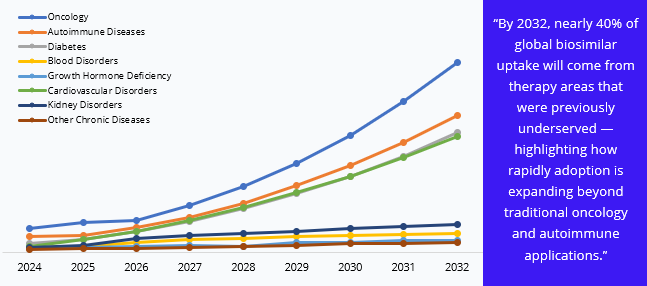
Biosimilars Market Growth by Indication (2024–2032)

Technological innovations, such as advanced cell line development, bioreactor optimization, and analytical characterization techniques, are improving production efficiency, reducing batch failures, and enabling faster time-to-market for biosimilars.

Regional dynamics reveal a clear divide between established and emerging markets. North America leads with a 42.24% market share, supported by robust regulatory frameworks (FDA interchangeability approvals), advanced healthcare infrastructure, and high prescriber confidence in biosimilars. Europe follows closely by having 33.26% market share, with EMA-guided approvals, tender-based pricing systems, and government cost-containment policies driving adoption. Asia Pacific, however, is expanding at a 15%+ CAGR, led by China, India, Japan, and South Korea, where rising chronic disease prevalence, government initiatives, and the growing biologics manufacturing base are accelerating biosimilar penetration.

Chart Loading...

Chart ID: 6927f95a2a2df399f3e9ffda

The competitive landscape is dominated by multinational pharmaceutical companies such as Pfizer, Sandoz (Novartis), Amgen, Celltrion, and Samsung Bioepis, who collectively control a significant share of global biosimilar approvals and commercialization. Alongside them, emerging innovators like Biocon, Coherus BioSciences, mAbxience, and Oncobiologics are reshaping specialized domains such as monoclonal antibodies, insulin, and growth hormone biosimilars. Contract manufacturing organizations (CMOs) are also increasingly influential, providing scalable production capabilities to meet global demand and ensuring high-quality compliance with stringent regulatory standards.

The defining question for the decade ahead is no longer simply how many biosimilars are launched, but how efficiently and affordably each therapy reaches patients while maintaining clinical efficacy and safety. This market forms the foundational architecture for the next generation of accessible, cost-effective healthcare, redefining patient outcomes, healthcare expenditure, and biologic therapy adoption worldwide.

Table of contents

BIOSIMILARS MARKET ANALYSIS

$1,449

Biosimilars Market (Market Size, Forecasts, Pricing, Supply Chain, Regulations, Demand)
The single-page market truth — value, trajectory, and the supply-chain levers that will decide winners over the next decade. Data-first, investor-ready, instantly actionable.

This section delivers the market backbone: historical, 2024 baseline, 2025–2032 forecasts, pricing benchmarks, and supply-chain heatmaps. It quantifies biosimilar adoption by therapy area, pricing by molecule type, regional splits, and manufacturing/capacity constraints.

A1. Biosimilars Market: Overview & Snapshot

A2. Biosimilars Market: Segmentation & Forecast

  • By Drug Class (Monoclonal Antibodies (mAbs) • Granulocyte Colony-Stimulating Factor (G-CSF) • Insulin, Anticoagulants • Recombinant Human Growth Hormone (rhGH) • Teriparatide • Glucagon-Like Peptide-1 (GLP-1) • Other Biologics)

  • By Indication / Therapy Area (Oncology • Autoimmune Diseases • Diabetes, • Blood Disorders • Growth Hormone Deficiency • Cardiovascular Disorders • Kidney Disorders • Other Chronic Diseases)

  • By Manufacturing Type (In-house Manufacturing • Contract Manufacturing (CMO/CDMO))

  • By Distribution Channel (Hospital Pharmacies • Retail Pharmacies • Online Pharmacies)

  • Biosimilars Market By Region & Country

  • TAM–SAM–SOM Framework

  • Comparative Forecast vs Other Published Studies

A3. Biosimilars Market: Pricing & Cost Structure Analysis

  • Benchmark Pricing (EU Tender Prices • U.S. WAC • ASP Trends)

  • Price Erosion Patterns Post-Launch (6M • 12M • 24M)

  • Regional Price Variability (US • EU • Japan • Korea • India • China)

  • COGS Breakdown for Biosimilars (Upstream • Downstream • QA/QC • Fill-Finish)

  • Impact of Interchangeability & Substitution Rules on Price Strategy

  • Business Model Types: Tender-Based • Volume-Based • Partnership Co-Development

A4. Biosimilars Market: Supply Chain & Manufacturing

  • Global Biomanufacturing Capacity Mapping (Mammalian • Microbial)

  • CDMO Footprint Analysis (Lonza • Samsung Biologics • WuXi Bio • Rentschler)

  • Fill-Finish Capacity Constraints

  • Cold Chain & Distribution Requirements

  • Raw Material Dependency (Media, Resins, Single-Use Systems)

  • Supply Chain Risk Assessment (Quality Issues • GMP Gaps • Regulatory Shutdowns)

A5. Biosimilars Market: Regulatory & Standards

  • FDA (351(k)) Pathway Analysis

  • EMEA Biosimilars Guidelines

  • Interchangeability Requirements (U.S.)

  • Naming Conventions (INN + Suffix)

  • Comparability Guidelines (Quality • Nonclinical • Clinical)

  • Pharmacovigilance Requirements

  • Country-Level Approval & Substitution Policy Mapping

A6. Biosimilars Market: Demand & Utilization

  • Demand Drivers by Therapy Area (Oncology, Autoimmune, Diabetes etc.)

  • Hospital vs Retail Utilization Patterns

  • Impact of Payer Policies (Formulary Position, Step Therapy)

  • Comparative Uptake (US vs EU vs Emerging Markets)

  • Volume-to-Value Conversion (Demand Elasticity Models)

  • Utilization Constraints (Physician Perception • Switching Barriers)

A7. Sectional Recommendation

BIOSIMILARS MARKET DYNAMICS

$500

Biosimilars Market (PESTLE • PORTER • DROC • Trends • Policy Forces)

Not just trends — the structural forces, regulatory frameworks, and market dynamics that convert biosimilars into essential therapy options. This is the ‘why now’ playbook for boardroom decisions.

Deep diagnostics of supply-demand drivers, regulatory triggers (safety, healthcare, energy), and macro-policy forces that will reshape demand curves. Includes DROC (Drivers, Restraints, Opportunities, Challenges), PESTEL, PORTER and scenario sensitivity tests tailored for board-level strategy.

B1. Emerging Biosimilars Market Industry Trends

B2. Biosimilars Market: Drivers, Restraints, Opportunities, Challenges (DROC)

B3. Biosimilars Market: PORTER’s Five Forces

B4. Biosimilars Market: PESTLE Analysis

B5.Biosimilars Market: Key Opinion Leader (KOL) Insights

B6. Biosimilars Market: Sensitivity Analysis & Risk Matrix

B7. Sectional Recommendation

BIOSIMILARS COMPETITIVE LANDSCAPE

$1,000

Biosimilars Market (Benchmarking • Profiles • Region Players • Market Share (%) • Competition Matrix • IP)
Who actually owns market share and perception? A battle-map of ecosystem control — molecule portfolios, manufacturing scale, regulatory approvals, and therapeutic reach. Must-read for investors, pharma strategists, and procurement teams.

A global competitive architecture analysis reflecting manufacturing scale, portfolio depth, regulatory approvals, commercialization speed, and therapeutic dominance. Essential for procurement, partnerships, and M&A pipelines.

C1. Biosimilars Market : Competition Matrix (Portfolio Depth × Manufacturing Scale × Market Reach)

C2. Biosimilars Market Structure (Leaders • Mid-Tier • Regional Players)

C3. Global Biosimilars Key Player Benchmarking (Portfolio • AI Capability • Efficiency • Scale)

C4 .Biosimilars Market Regional Competitor Mapping

C5. Biosimilars Market Intellectual Property Landscape (SECTION 10 moved here)

  • Biologics Patents & Biosimilar Opportunities

  • Process Patents • Cell Lines • Formulation IP

  • Top Patent Holders (US • EU • JP • CN)

  • FTO & Licensing Scenarios

C6. Biosimilars Market: M&A, Licensing, Co-Development & Partnerships (2020–2024)

C7. Biosimilars Market: Competitive Strategy Architectures

C8. Sectional Recommendation

C9. Company Profiles (34 Players + Startups)

Tier-1 Leaders – North America (US)

  1. Amgen Inc. – Biosimilars, oncology, nephrology, immunology therapies; global manufacturing footprint; extensive R&D pipelines.

  2. Pfizer Inc. – Global biosimilars portfolio including oncology, immunology; partnerships for development and commercialization; strong regulatory experience.

  3. AbbVie Inc. – Biosimilars and originator biologics in immunology, oncology; AI-driven drug development; strong US & EU presence.

  4. Eli Lilly and Company – Focus on monoclonal antibody biosimilars; strong clinical trial execution; manufacturing scale in US & Europe.

  5. Viatris Inc. (Mylan) – Global biosimilars and generics; strong commercialization channels; multiple licensing partnerships.

  6. Amneal Pharmaceuticals LLC – Biosimilars in development for oncology and autoimmune therapies; active in US & EU markets.

  7. Coherus BioSciences, Inc. – Monoclonal antibody biosimilars; innovation in process optimization; focus on cost-effective production.


Tier-1 Leaders – Europe

  1. F. Hoffmann-La Roche Ltd. (Switzerland) – Oncology and immunology biologics; strong patent portfolio; collaboration with biotech startups for biosimilars.

  2. Sandoz International GmbH (Switzerland) – Pioneer in biosimilars; large portfolio including oncology, hematology; global manufacturing & distribution.

  3. Fresenius Kabi AG (Germany) – IV biosimilars; infusion therapy solutions; strong European market reach.

  4. STADA Arzneimittel AG (Germany) – Biosimilars in autoimmune & oncology therapy; EU-focused commercialization; strategic partnerships.

  5. Boehringer Ingelheim International GmbH (Germany) – Biologics & biosimilars; advanced process technologies; strong R&D for emerging biologics.

  6. Hikma Pharmaceuticals (UK/Jordan) – Biosimilars in oncology & immunology; regional commercialization; growing EU & Middle East footprint.

  7. Intas Pharmaceuticals / Accord Healthcare (India/UK) – Oncology & immunology biosimilars; EU commercialization; multiple licensing deals.


Tier-1 Leaders – Asia

  1. Celltrion Healthcare Co., Ltd. (South Korea) – Large biosimilar portfolio; global commercialization (EU, US, Asia); oncology & autoimmune focus.

  2. Samsung Bioepis Co., Ltd. (South Korea) – Biosimilars for autoimmune & oncology; strong partnerships with global pharma; scalable production.

  3. Teva Pharmaceutical Industries Ltd. (Israel) – Biosimilars in multiple therapeutic areas; licensing partnerships; strong regulatory capabilities.

  4. Dr. Reddy’s Laboratories Ltd. (India) – Global biosimilar portfolio; oncology & nephrology; active in EU & US markets.

  5. Biocon Limited (India) – Monoclonal antibodies, insulin, immunology biosimilars; global partnerships with MNCs.

  6. Lupin Limited (India) – Focused on oncology & immunology biosimilars; expanding manufacturing scale; EU and US approvals.

  7. Cipla Limited (India) – Biosimilars in oncology & respiratory therapies; active in EU, US, emerging markets.

  8. Zydus Cadila (India) – Oncology & autoimmune biosimilars; expanding global presence; strong R&D pipeline.


Innovators / Emerging Players – APAC & Global

  1. Bio-Thera Solutions, Ltd. (China) – Monoclonal antibody biosimilars; strong clinical pipeline; EU & US filing experience.

  2. Shanghai Henlius Biopharmaceuticals, Inc. (China) – Oncology & autoimmune biosimilars; advanced R&D and manufacturing capabilities.

  3. Apogen Inc. (South Korea) – Biosimilar development in oncology; emerging commercial capabilities.

  4. Kyowa Kirin Co., Ltd. (Japan) – Biosimilars & specialty biologics; clinical development; regional market focus.

  5. Daiichi Sankyo Company, Ltd. (Japan) – Oncology & rare disease biosimilars; growing global commercialization.

  6. Alvotech (Iceland) – Global biosimilars portfolio; partnerships in US & EU; monoclonal antibodies & biologics focus.

  7. NeuClone Biotech (Australia) – Emerging biosimilar innovator; focus on cost-effective monoclonal antibodies.

  8. Apotex / Biocon Biologics partnerships (Canada/India) – Co-development of monoclonal antibody biosimilars; global commercialization focus.

  9. BIOCAD / Biocad (Russia/EMEA-focused) – Oncology & autoimmune biosimilars; regional market expansion; clinical development.

  10. Hetero / Cipla (India) – Biosimilar production & development; emerging global partnerships; cost-efficient manufacturing.

  11. Sandoz / Biocon Biologics collaborations – Global biosimilars co-development; EU & US regulatory approvals; pipeline expansion.

  12. Mylan (Viatris) – Global biosimilars commercialization; licensing partnerships; oncology & immunology therapies.

  13. mAbxience (Argentina / Global) – Biosimilars in oncology & immunology; emerging global commercialization; focus on monoclonal antibodies.

  14. Oncobiologics (US) – Development of oncology biosimilars; early-stage

BIOSIMILARS MARKET STRATEGIC BLUEPRINTS & OUTLOOK

$999

Biosimilars Market (Future Roadmaps • Innovation • Scenarios • Recommendations)

Actionable blueprints and investor-ready scenarios — exactly what CEOs and strategy teams need to convert into revenue plays.

High-impact strategy frameworks for CEOs, investment teams, and launch excellence planners

D1. Biosimilars Market: Ecosystem & Value Chain

  • End-to-end value chain: R&D → Manufacturing → Fill-Finish → Distribution → Hospital/Pharmacy

  • Roles: Innovators • CDMOs • Pharma Companies • Distributors • Retail Networks

  • Key levers: Clinical trials • AI analytics • Predictive market insights

D2. Biosimilars Market: Technology Landscape

  • Core platforms: Recombinant DNA • Microbial • Mammalian • Plant-Based Systems

  • AI-enabled drug development & forecasting

  • Emerging trends: mRNA biosimilars, Novel formulations

D3. Biosimilars Market: Strategic Outlook

  • High-value Growth Matrix (Molecule × Therapy Area × Region)

  • Entry playbooks: Hospital tenders • Retail partnerships • Co-development deals

  • Strategic levers: Regulatory excellence • IP portfolio • Ecosystem partnerships

D4. Biosimilars Market: Scenario Forecasting

  • High/Base/Low adoption scenarios

  • Impact metrics: Revenue • Volume • Market Penetration

  • Sensitivity to regulation, pricing, and supply chain disruption

D5. Biosimilars Market: Adjacent Market Benchmarking

  • Comparison with Biologics & Generics

  • Innovation maturity & capability overlap

D6. Biosimilars Market: Competitive Strategy

  • Business model evolution: R&D-heavy → CDMO partnerships → Platform-based licensing

  • Moats: IP portfolio • Clinical trial data • Manufacturing know-how

D7. Biosimilars Market: Innovation & M&A

  • Patent hotspots: Biologics • Formulation • Cell Lines

  • M&A themes: Co-development, Licensing, CDMO integration

D8. Product-to-Platform Transition

  • Roadmap: Molecule → Formulation → Integrated Therapy Platform

D9. Partnerships

  • Pharma–CDMO–Distributor–Hospital collaboration chains

  • Key alliances: Oncology, Autoimmune, Diabetes therapies

D10. Analyst Strategic Recommendations

  • Top 12-month actions

  • High-opportunity regions

  • Risk priorities: Supply chain • Regulation • Market acceptance

BIOSIMILARS MARKET DASHBOARD SUITE (One-Page Data Intelligence)

$500

Biosimilars Market (MMR-Statistics Style Visualization Layer)
One page that sells the entire report — crisp country/region/year KPIs, growth levers and competitor heatmaps designed for decks and investor memos.

A dashboard with country-wise and region-wise market numbers, top-10 competitor heatmap, therapy-area CAGR table, and embedded graphs. Includes downloadable Excel data, PPT-ready charts, and editable visuals.

E1. Biosimilars Market Dashboard

  • Biosimilars Market Size

  • Biosimilars Market Forecast

  • Region Split (Map/Donut)

  • Top 10 Therapy Areas

  • Molecule Share (Monoclonal Antibodies • Insulins • Growth Hormones)

  • CAGR Heatmap

  • Demand Hotspots

E2. Biosimilars Market Competitor Dashboard

  • Market Share (Top 10)

  • Regional Presence Map

  • Patent Ownership Bars

  • Benchmarking Radar

  • M&A Activity Timeline

E3. Biosimilars Market Supply Chain Dashboard

  • Manufacturing Capacity

  • CDMO Footprint

  • Lead Time Trends

  • Risk Heatmap

E4. Biosimilars Market Investment Dashboard

  • Global Funding Flow

  • Valuation Multiples

  • Investor Activity

  • ROI & Payback Charts

E5. Biosimilars Market Infrastructure Dashboard

  • Distribution Density by Country

  • Hospital/Clinic Reach

  • Top 50 Biosimilars Launches

Related statistics

Related statistics to Biosimilars

Access up-to-date statistics for this topic.

Visit Biosimilars topic

Customize this research

Let us tailor this report to your brief

Blend your internal inputs with our models, adjust definitions, and specify the exact cuts you need so the deliverable ships in your format.

Incorporate your taxonomy and data sources
Deliverables in your preferred format and structure
Targeted deep-dives by application, geography, customer, or competitor
Personalization scopes of any depth with fast turnaround