

The global Dry Shampoo Market is undergoing one of the most influential shifts seen in the personal-care sector in the last decade. What began as a quick-fix beauty hack has transformed into a mainstream grooming essential shaped by new-age consumer behaviour, clean-beauty expectations, and accelerating global lifestyles. In 2024, the market was valued at USD 3.45 billion, and by 2032 it is forecast to reach USD 5.71 billion, expanding at a CAGR of 6.50%. This upward trajectory is not merely a result of convenience; it reflects a deeper evolution in the way consumers balance time, appearance, sustainability, and water efficiency.
Key Highlights
The Dry Shampoo Market rises from USD 3.45Bn (2025) to USD 5.71Bn by 2032, growing at 6.50% CAGR driven by fast-paced lifestyles, waterless grooming, and clean-beauty adoption.
North America dominates value share, while Asia-Pacific leads global expansion—India, China, Japan and Indonesia forming the strongest high-growth demand cluster.
Premium products priced USD 15–40 surge across the U.S. and Europe, while mass-market formats at USD 5–7 drive volume in India, LATAM and Southeast Asia.
Online retail grows at 7.02% CAGR, with Amazon, Sephora, Walmart, Target and Nykaa accelerating digital discovery, influencer-driven demand, and subscription-based repeat sales.
Clean-beauty and sustainability redefine competition- brands rapidly shifting to sulfate-free, paraben-free, low-VOC, biodegradable and plant-based formulations under EU and global green policies.
Chart Loading...
Chart ID: 69294238540c1ff5bab2ecae
replace daily hair washing with waterless alternatives. Dry shampoo’s ability to eliminate oil, refresh texture, and add volume in under a minute has turned it into an everyday essential in the U.S., U.K., France, Japan, South Korea, and India. The category is also benefiting from the global shift toward low-wash lifestyles an emerging norm in urban markets where grooming needs rise, but available time does not.
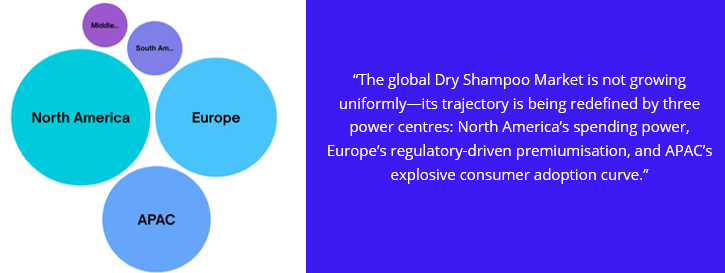
Regional patterns bring additional clarity to market momentum. North America leads global value share due to strong premium penetration, influencer-led brand loyalty, and high visibility across Amazon, Sephora, Walmart, and Target. Europe mirrors this premium trajectory but is more deeply shaped by environmental regulations, with consumers gravitating toward natural, vegan, sulfate-free, and low-VOC formulas. Asia-Pacific is the standout growth engine: India is experiencing heightened awareness led by digital retail and beauty creators; China and Japan demonstrate high product experimentation; and Indonesia shows rapid acceptance driven by affordability and availability. South America and Africa, meanwhile, remain mass-market territories with strong demand for budget-friendly aerosols sold through supermarkets and drugstores.
The clean-beauty movement is driving some of the most notable product changes. Consumers across continents are rejecting harsh chemicals, prompting brands to reformulate using lightweight plant starches, botanical powders, and dermatologist-tested blends. European regulations such as the Green Deal and Circular Economy Action Plan have forced manufacturers to rethink propellants, packaging materials, and sustainability metrics. Emerging innovations include refillable bottles, non-aerosol dispensing, micro-fine powder systems, and ingredient transparency supported by QR-coded traceability.
Category segmentation highlights where the next phase of growth lies. Sprays continue to dominate due to instant usability, but powder formats are gaining strong traction among natural-beauty shoppers, sensitive scalp users, and consumers avoiding aerosol residues. Women still hold the highest consumption share, though men are emerging as a fast-expanding grooming demographic, particularly in North America, India, Brazil, and Southeast Asia. Distribution behaviour shows a dramatic shift toward digital: the online channel is expected to grow at 7.02% CAGR, propelled by search-driven discovery, influencer reviews, D2C brand launches, and algorithmic product recommendations.
Competition intensifies each year as brands refine their value propositions. Batiste remains the global benchmark for instant refresh and volumizing performance. Dove continues to emphasise its sustainability roadmap with eco-conscious raw materials and cleaner propellants. Klorane, Amika, Living Proof, OUAI, Bumble & Bumble, and Lush strengthen the premium tier with texture-enhancing variants, dark-hair solutions, sweat-control formulas for fitness users, and colour-preserving blends. In Asian markets, local brands are leveraging Ayurvedic and plant-based positioning to attract natural-first consumers.
Chart Loading...
Chart ID: 6929369db61c61778200b135
Price segmentation reveals clear market layers. Premium products priced USD 15–40 thrive in North America, Europe, and Japan due to strong brand equity and ingredient purity. Mass-market formats priced USD 5–7 dominate India, Southeast Asia, Brazil, and South Africa where affordability dictates volume.
The future of the Dry Shampoo Market will be shaped by sustainability requirements, hybrid formulations, AI-driven personalisation, and stronger dermatological claims.