

The Skin Boosters Market is undergoing a structural transformation as demand for non-surgical aesthetic treatments accelerates worldwide. Valued at USD 1358.25 Mn in 2024 and USD 1492.17 Mn in 2025 , the market is projected to reach USD 3263.80 Mn by 2032 at a CAGR of 11.58%, driven by rising beauty consciousness, digital influence, and growing access to aesthetic clinics.
Skin Boosters Market: Key Highlights
Hyaluronic Acid (HA) Leads Ingredient Share: HA-based skin boosters dominate the market with strong clinical adoption, high biocompatibility, and the ability to deliver deep skin hydration and elasticity improvement.
Rising Popularity of Minimally Invasive Aesthetic Procedures: The surge in anti-aging treatments, microinjection therapy, and face rejuvenation products is accelerating the adoption of injectable skin boosters globally.
Asia Pacific Leads Global Demand: Countries such as South Korea, China, and Japan are driving high-volume consumption due to strong beauty culture, product innovation, and the availability of cost-effective treatments.
North America & Europe Gain Traction: Increasing acceptance of cosmetic injectables, rising med-spa chains, and strong consumer spending are fuelling market expansion.
Competitive Activity Increases: Global and regional brands are expanding via FDA/CE approvals, strategic collaborations, and product diversification.
Chart Loading...
Chart ID: 6927ef1d2a2df399f3e9fe5f
The market is categorized by ingredient type, each contributing uniquely to treatment outcomes
Hyaluronic Acid (HA): The largest segment, HA boosters, enable deep hydration, enhanced glow, and improved skin texture. Their safety profile, reversibility, and instant results make HA the global gold standard.
Polydeoxyribonucleotides (PDRN): Known for tissue repair and regeneration, PDRN boosters are gaining strong adoption across Asia.
Poly-L-Lactic Acid (PLLA) / Poly-D, L-Lactic Acid (PDLLA): These bio-stimulating injectables promote long-term collagen formation and are favoured for anti-aging and elasticity restoration.
Polycaprolactone (PCL): PCL-based boosters offer sustained collagen synthesis and longer-lasting rejuvenation outcomes.
Exosomes: A fast-growing premium category, exosome boosters enhance cell communication, regeneration, and post-procedure recovery, making them a luxury treatment op
Chart Loading...
Chart ID: 6927ed9f1efbb41495da54dc
North America dominates global revenues with 32.59% market share, led by technologically advanced aesthetic hubs, early adoption trends, and the availability of affordable treatments.
Europe supported by strong dermatology infrastructure, CE-certified product availability, and rising preference for non-invasive rejuvenation. Asia Pacific is expanding rapidly with a 24.52% share, driven by increasing consumer awareness, med-spa growth, and dermatologist-led adoption.
Title: Skin Boosters Market: Regional Breakdown by Market Share (%) and Market Size (2024)
Chart Loading...
Chart ID: 6927d54758a281fde4cac100
The competitive environment includes leading aesthetic manufacturers, dermal filler companies, biotech innovators, and emerging Asian brands specializing in HA boosters, PDRN injectables, PLLA/PCL bio-stimulators, and exosome formulations. Strategic partnerships, new product launches, regulatory approvals, and regional expansions remain central to market leadership.
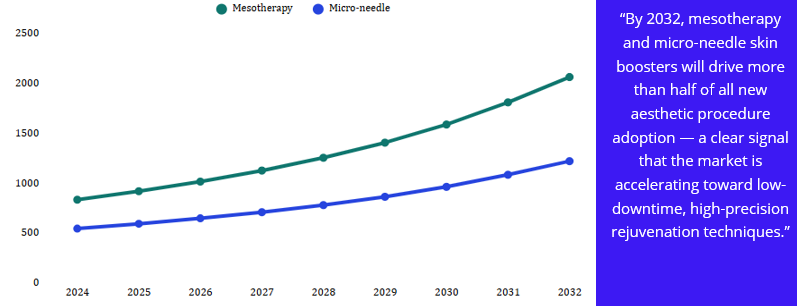
Title: Global Skin Boosters Technology Market by Type (2024–2032): Mesotherapy, Micro-needle
The next decade of the Skin Boosters Market will be defined not only by new formulations but also by clinical efficacy, treatment personalization, and the scalability of aesthetic technologies across global markets .